
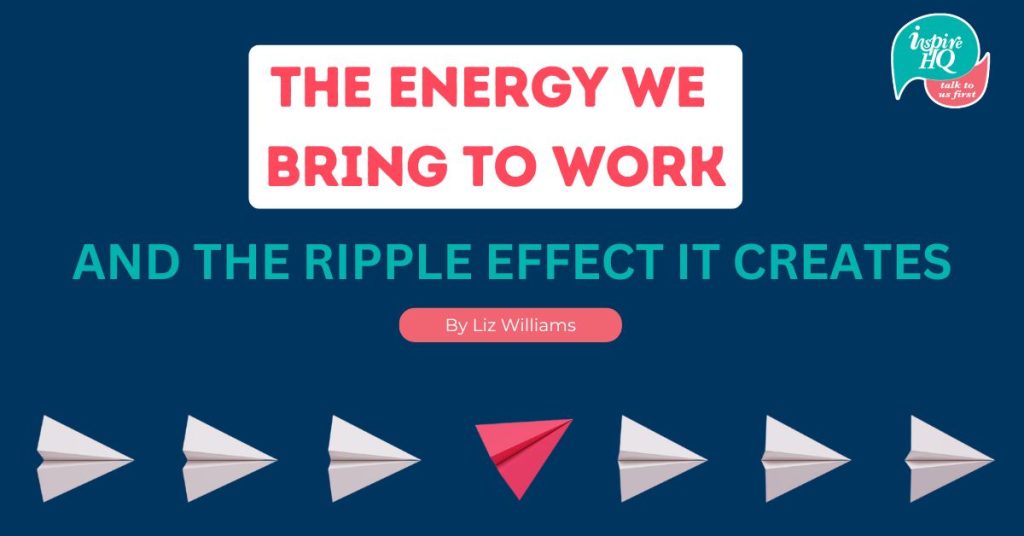
Our motivation and energy speak long before our words do.
It walks into meetings before we do. It shapes how safe people feel around us. It influences momentum, morale, motivation, and even conflict. Whether we realise it or not, every workplace interaction creates a ripple and the energy we bring often becomes the energy others experience.
Most teams spend time talking about performance, accountability, communication and culture. Far fewer talk openly about the emotional undercurrent sitting beneath all of it: energy and motivation.
Yet these factors are often the difference between a workplace that feels collaborative and one that doesn’t.
Energy Is Contagious
Humans naturally absorb emotional cues. One frustrated person can shift the mood of an entire room, while one calm and grounded leader can steady a team during uncertainty.
This doesn’t mean we need to be relentlessly positive. What matters more is awareness.
- Are we bringing tension into conversations without recognising it?
- Are we unintentionally shutting people down through impatience, tone, or disengagement?
- Are we expecting others to motivate us while taking little ownership of what we contribute ourselves?
Energy is contagious, but so is ownership.
Understanding What Fills Our Cup
Part of taking ownership is understanding what sustains us and what depletes us.
For some people, energy comes from collaboration, purpose, autonomy, creativity, or connection. For others, ongoing conflict, unclear expectations, constant urgency, or lack of recognition can quickly drain motivation.
The challenge is that many people operate from depletion without recognising the impact it is having on those around them.
And depleted people rarely communicate at their best.
Self-awareness helps us notice when frustration is beginning to leak into conversations, when motivation is dropping, or when our energy is no longer aligned with how we want to show up.
This isn’t about avoiding difficult seasons. It’s about recognising that sustainable workplaces require people to understand both their own emotional regulation and the impact their behaviour can have on others.
Owning Our Motivation
One of the harder workplace truths is that motivation is not always something that simply arrives naturally. Sometimes it’s something we actively choose to cultivate.
There will always be days where people feel stretched, tired, overwhelmed, or distracted. That’s human. Problems arise when responsibility for motivation is placed entirely onto others.
Over time, unmanaged energy can become habitual, leading to:
- chronic negativity
- emotional withdrawal
- passive disengagement
- defensiveness
- visible frustration
When repeated often enough, these behaviours quietly shape team culture.
Healthy teams recognise that while workplaces absolutely influence motivation, individuals also have a responsibility to recognise when their own energy is impacting others.
The Importance of Repair
Every workplace experiences tension, misunderstandings, or emotional spillover. This isn’t dysfunction, it’s part of working alongside humans under pressure.
What matters is whether repair follows.
Repair is the ability to recognise when our words, tone, behaviour, or energy may have impacted someone else and be willing to address it openly rather than avoiding it.
Sometimes repair sounds like:
- “I realise I was more frustrated than I intended in that meeting.”
- “I don’t think I showed up particularly well in that conversation.”
- “I can see how that may have landed for you.”
Repair requires self-awareness, humility, and emotional maturity because it asks us to focus not only on intent, but also impact.
Without repair, workplaces often accumulate emotional residue, unresolved frustration, hesitation, resentment, or disconnection that quietly builds over time.
The Ripple Effect We Create
One of the most powerful parallels can be seen in horses. Horses are highly attuned to the emotional state and nervous system responses of those around them. A calm presence settles them; an anxious or frustrated presence creates unease almost immediately.
Teams are not so different.
People subconsciously absorb stress, tension, calmness, optimism, and emotional inconsistency from those around them. A leader’s anxiety can heighten uncertainty across a team, while one grounded and emotionally aware person can help stabilise an entire room.
Humans are constantly reading the emotional environment around them to look for safety, trust, and consistency.
That’s why self-awareness and repair matter so deeply.
Culture is rarely built in big moments. It is built in repeated daily interactions:
- the energy we bring into meetings
- the emotional tone we create in conversations
- the tension we leave unresolved
- and the ownership we take when we miss.
The strongest workplace cultures are not built by people who never get it wrong. They are built by people willing to recognise when they have and who choose to repair rather than retreat.