
I am lucky enough to be trusted, invited and given the opportunity to work with businesses where leaders are willing to invest in their people.
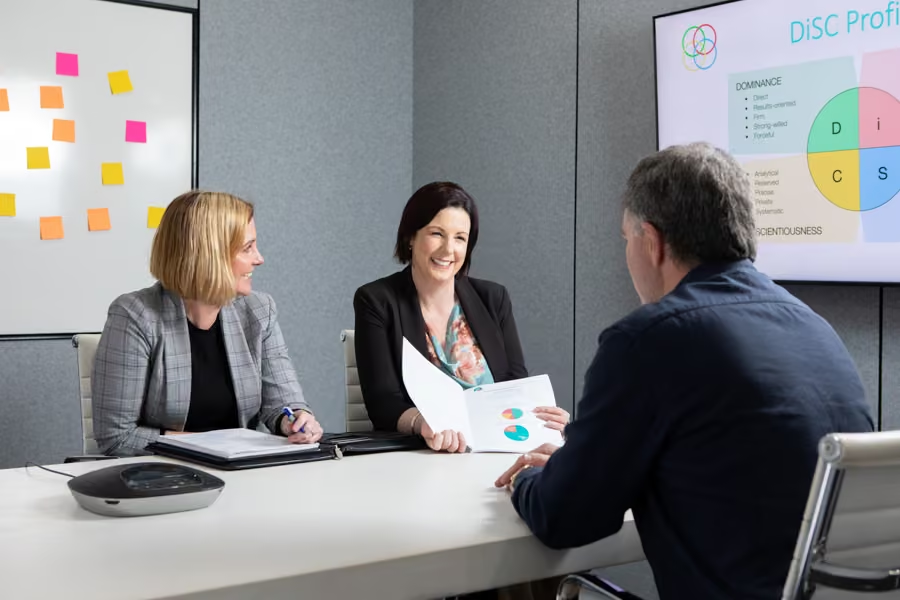
I get to step into rooms and spend time with teams, understanding a little more about their individual nuances, relationships and dynamics. To me, being invited into that space is a significant sign that a business genuinely values its people.
And I fully appreciate the investment that goes into that — not only the time and resources involved in our sessions, but the time people take away from their day-to-day work to be there.
I am also passionate about making sure we get the most out of that investment.
There is one thing I regularly encourage businesses to consider afterwards:
Share lunch.
You’ve already invested you’ve spent the morning learning together.
You’ve had conversations, asked questions, challenged assumptions and perhaps looked at familiar issues from a different perspective.
So why rush everyone back to their desks?
Sit down.
Have lunch.
Keep the conversation going.
Because sometimes the most useful part of a training session happens after the formal learning has finished.
It happens in the quieter conversations. The reflections. The unexpected realisations.
“I hadn’t thought about it that way before.”
“I never really understood why you do that, but now I do.”
Those moments matter.
They can help people understand why a colleague may have approached something differently, why a conversation went off track, or why two people have misunderstood each other in the past.
More importantly, they create an opportunity to think about what might be different next time.
Give people time to process
We often think of training as something that happens during the session.
The trainer presents.
People listen.
Questions are asked.
Activities are completed.
Then everyone returns to work.
But learning doesn’t always happen neatly within those boundaries.
Sometimes it takes a conversation afterwards to make sense of what we’ve heard.
Sometimes it is hearing a colleague’s perspective that makes something click.
And sometimes the person sitting beside us has an insight that never would have come up in the formal session.
That’s why I like shared lunch after training.
It isn’t about extending the workday.
It is about giving people space to process what they have just learned — together.
Connection matters after difficult conversations too
The same principle applies beyond training.
If you’ve had a difficult conversation with someone, connection doesn’t mean avoiding the conversation.
Sometimes it means having it — and then staying engaged afterwards.
There is a powerful message in being able to say, through your actions:
I care enough to have the hard conversation, and I’m still here to support you.
That is where trust is built.
Not because every conversation is easy, but because people know that difficult conversations don’t automatically mean the relationship ends.
Don’t rush back to the desk
We are often very good at moving on.
Training finishes.
Meeting ends.
Next task.
Next deadline.
Next email.
But perhaps we could sometimes pause before moving on.
Have the coffee.
Share the lunch.
Ask, “What did you take from this?”
Give people the opportunity to talk about what they’ve heard and what it might mean for them.
Because the most valuable learning may not happen when someone is standing at the front of the room.
It might happen afterwards, around a lunch table, when people have the time and space to connect the learning to each other and to their own experience.
The training might finish at lunchtime. The learning doesn’t have to.
Sometimes, all we need to do is give people the time to keep the conversation going.