
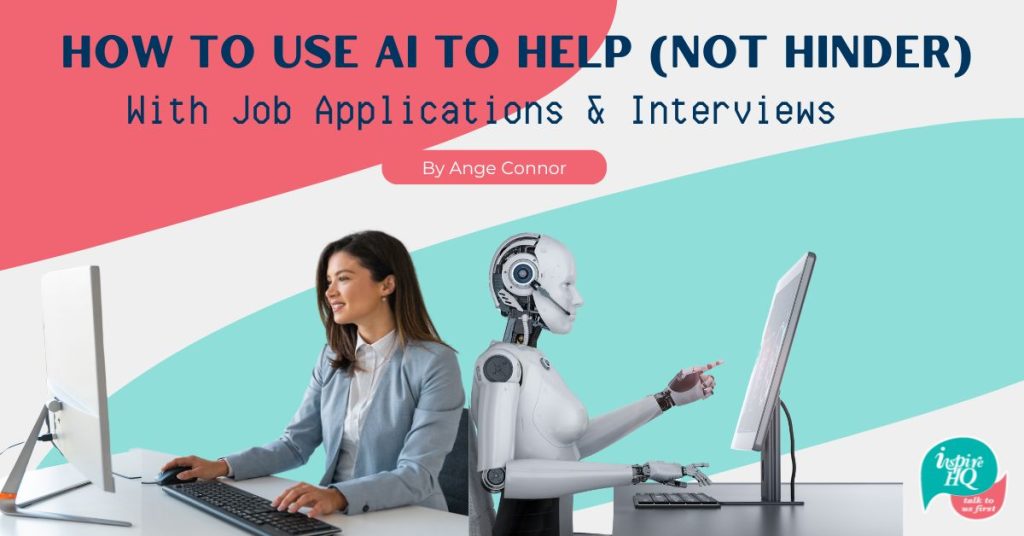
AI is now part of the job search whether we like it or not. As a career coach, I hear all the time how much people don’t enjoy writing job applications or preparing for interviews. It’s time consuming and it’s hard work so utilising AI to make it easier is a given.
In my opinion, there is a fine line between AI helping or hindering you with landing your dream job. I’m starting to see a growing divide. The strongest candidates are using AI to sharpen their thinking while everyone else is using it to think for them.
And, trust me, it shows. It shows in your application. It shows at interview.
If you are relying on AI to do the heavy lifting, you are most likely weakening your application without even realising it.
Here are my tips on how to use AI to help with job applications and interviewing – and where to be wary of it working against you.
Writing your resume
AI is great for cleaning and polishing things up.
When writing your resume use it to:
- Turn your brain dump of skills, experience and responsibilities into clear, concise and structured bullet points
- Polish your language with stronger action verbs
- Frame your experience in a results – outcomes focused manner
- Compare gaps in your resume vs the job advert or position description, allowing you to address these gaps
Be careful it’s not hindering you by:
- Making you blend in with the crowd (all the other applications) – your resume might be polished and professional but it might fall into the trap of being bland and generic.
This looks like:
- Generic bullet points of skills and experience that could belong to anyone
- Buzz words with no depth or context
- A list of skills or experience that don’t demonstrate your abilities
- Language that looks and feels like a carbon copy of the job advert and position description
Used well, AI is a great editor, but it only works well if you give it good content to work with. If you are vague with what you give it to work with, you’ll get vague polished content back. Recruiters reject resumes because there is nothing there – no depth, no context in terms of skills and experience. If your resume looks and reads like every other candidate, chances are it will end up in the thanks but no thanks pile.
Writing your application letter and key selection criteria
Knowing where to start when writing an application letter and KSC is sometimes the hardest part, which is where AI can be useful.
When writing your application letter and KSC use AI to:
- Help you get started and improve the flow of the documents; breaking down the sections you want to cover off in your application letter and breaking down what each KSC is actually asking you.
- As with your resume, it’s a great editor, use it to help polish, word-smith and turn a brain dump of content into professional sentences and statements.
- Turn your KSC responses into responses aligned to the STAR framework.
- Sometimes we can get a little tunnel visioned or feel like we are regurgitating the same info in job applications, especially when a KSC response is required. AI can be good for giving you / suggesting other angles to come at a response from – or highlighting elements you might not have considered.
Be careful it’s not hindering you by:
- Producing polished content with no depth – no examples of what you have actually done. AI needs the specific examples to be able to work with which relies on you thinking of the experiences you have had.
- You are being assessed on what you have actually done – not how well something is written. AI can’t come up with what you have done or invent credible experience, that’s where your input is required. Give AI poor or no experience then you’ll get generic, overly polished content that feels like it could apply to any candidate.
Preparing for Interview
Preparation and practice are key to helping you nail an interview. AI can be very powerful in helping you prepare but it doesn’t help you perform at interview – that’s all up to you. If you haven’t been smart about how you use AI to prep for an interview it will show and often leads to bombing at interview.
How to use AI for interview preparation:
- Have it generate practice interview questions; ice breaker questions, role specific questions and behavioural based questions. It’s not going to know exactly what questions you’ll be asked at interview but practicing interview questions will help you get in the mindset of the kind of questions that could be asked at interview.
- Use it to help you build structured responses to respond to questions using the STAR framework.
- Have it provide probing questions as follow up to initial questions to really put you through your paces.
- Give you feedback on if your response answered the question and how to refine your response.
Now, here’s where AI can lull you into a false sense of safety and be your undoing at an interview:
- Avoid memorising AI generated responses. The interviewer can tell – it comes across as not genuine and authentic. You also risk being completely thrown when you get a question that you haven’t got a memorised response for and when the interview asks probing questions you drop the ball.
- Responses to interview questions require specific examples to demonstrate or evidence your abilities. If you haven’t got the examples to put into AI, you’ll get generic, bland responses with no depth and context. This is where you really need to do the heavy lifting – AI can’t think for you.
- And here is what I consider the biggest danger – most people I talk to aren’t practicing for interviews by verbalising their interview question responses. Reading or listening to an AI generated interview question response doesn’t mean that when you verbalise it, you’ll articulate it correctly.
AI can’t polish your body language, your tone, your eye contact. So much of what we say is not just about the words we use. The real power of preparing for an interview comes from standing in front of the mirror and verbalising your response, honing it, tweaking it, perfecting it. You can read your AI generated response as many times as you like, you can memorise it, but I guarantee when you open your mouth at interview and verbalise it – it sounds and lands differently. Real interview preparation comes from practicing your responses out loud.
Interviews aren’t looking for polished perfect answers. We are looking for real thinking, real judgement and real communication. No matter how good AI currently is; it can’t do that for you.
When it comes to applying for jobs and interviewing, AI isn’t your competitive advantage, it’s another tool to have in your tool belt. Your advantage will come from your thinking – your specific experiences, your authentic communication. Focus on substance over polish, use AI to refine not replace and AI will only ever be as good as the content you put into it – you need to start with your own ideas, experiences and skills. That’s what will get you hired.