

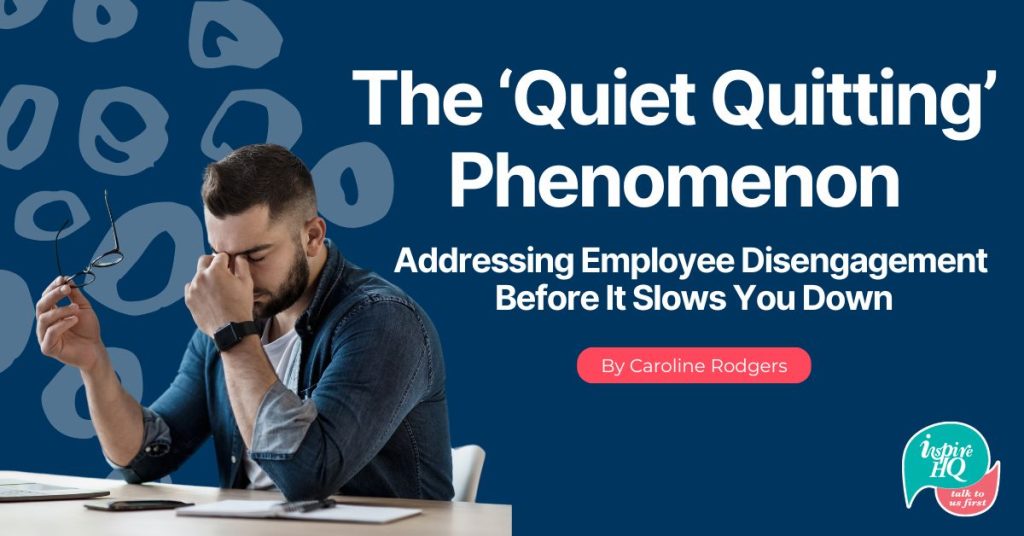
If you run a small or medium-sized business, you don’t need a report to tell you when something feels “off” in your team.
Energy drops.
Motivation fades.
People do what’s required—but not much more.
That’s what’s often labelled “Quiet Quitting”. And in a small team, the impact is anything but quiet.
In a large organisation, disengagement can hide. In a team of 10, 20, or even 50? It can be much more obvious—and like a shockwave, it spreads quickly.
Just one disengaged employee can mean:
- Slower customer response times
- Missed opportunities for improvement
- Extra pressure on others to “pick up the slack”
In short: less forward momentum where you can least afford it.
So, what is “Quiet Quitting” really?
Despite the name, Quiet Quitting is not about employees submitting their resignations en masse, checking out completely or slacking off.
It’s about people drawing a line: doing their job, meeting expectations and…. stopping there.
No extra effort.
No new ideas.
No going above and beyond.
And more often than not it’s not so much a problem in itself, it’s a signal that something else is amiss.
Quiet Quitting rarely comes down to employee laziness. It’s more often linked to things like:
- Blurred roles: People wearing too many hats for too long
- Lack of direction: Unclear priorities or shifting expectations
- Limited growth or professional development: No real answer to the “What’s next for me?” question
- Recognition gaps: Effort goes unnoticed, so it stops
- Leader fatigue: When managers and leaders are stretched thin, it trickles down to their teams
None of these are unusual in a growing business but left unaddressed, they add up.
The early signs (and how to address it):
Quiet Quitting doesn’t show up as sudden or dramatic underperformance. It’s more subtle:
- People stop contributing ideas
- Motivation and effort drop off
- Conversations become more transactional
- You hear less “we could try…” and more “just tell me what to do”
That shift—from engaged to simply compliant—is the real red flag.
So, what should you do?
It’s tempting to jump to quick fixes—but a few things tend to backfire:
- Assuming people are just unmotivated
- Throwing perks at the problem instead of addressing workload or clarity
- Ignoring it and hoping it resolves itself. Disengagement rarely fixes itself. It usually deepens.
The good news? You don’t need complex programs or expensive perks to turn things around.
A few simple habits go a long way:
- Talk and check-in with staff regularly, not just when there’s a problem: Short, consistent check-ins create space for honesty before frustrations build up.
- Get clear on roles and priorities: People can’t stay engaged if the target keeps moving—or isn’t clear to begin with.
- Notice effort (specifically, not generically): A quick, genuine “that made a difference” lands far better than occasional broad praise.
- Give people a say: Even small opportunities to contribute ideas or shape decisions can rebuild ownership and commitment.
- Respect boundaries: Ongoing and sustainable performance beats short bursts of burnout every time.
A useful reality check
Quiet Quitting isn’t just an employee issue—it’s often feedback on how the business is running day to day.
That’s not a criticism. It’s an opportunity.
For small and medium businesses, where culture is shaped in real time, small changes in communication, clarity, and recognition can have an outsized impact.
And when people feel heard, supported, and clear on where they’re going, they don’t tend to “quietly quit.” They lean back in.